caffeine
| Molecular & Flavor Profile | |
|---|---|
| Common name: | caffeine |
| IUPAC name: | 1,3,7-trimethylpurine-2,6-dione |
| SMILES: | CN1C=NC2=C1C(=O)N(C(=O)N2C)C |
| CAS: | 58-08-2, 95789-13-2 |
| Flavor Profile: | odorless, bitter |
| FEMA Flavor Profile: | Not Available |
| FEMA Number: | 2224 |
| Taste: | bitter taste |
| Odor: | odorless |
| Functional Groups: | oxo(het)arene, aromatic compound, heterocyclic compound |
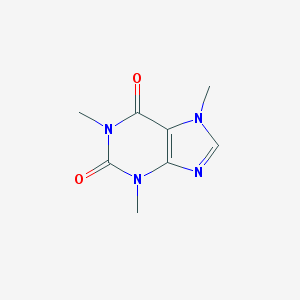
Physicochemical Properties
- Molecular weight: 194.194 g/mol
- HBD count: 0
- HBA count: 3
- Number of rotatable bonds: 0
- Complexity: 293.0
- Topological Polor Surface Area: 58.4 A^2
- Monoisotopic Mass: 194.08 g/mol
- Exact Mass: 194.08 g/mol
- XlogP: -0.1
- Charge: 0 C(coulomb)
- Heavy Atom Count: 14
- Atom Stereocenter Count: 0
- Defined Atom Stereocenter Count: 0
- Undefined Atom Stereocenter Count: 0
- Bond Stereocenter Count: 0
- Defined Bond Stereocenter Count: 0
- Undefined Bond Stereocenter Count: 0
- Isotope Atom Count: 0
- Covalently Bonded Unit Count: 1
- InChI: InChI=1S/C8H10N4O2/c1-10-4-9-6-5(10)7(13)12(3)8(14)11(6)2/h4H,1-3H3
- Volume 3D: 143.9
Nomenclature
- Common name: caffeine
- IUPAC name: 1,3,7-trimethylpurine-2,6-dione
- CAS numbers: 58-08-2, 95789-13-2
- SMILES: CN1C=NC2=C1C(=O)N(C(=O)N2C)C
- InChI: InChI=1S/C8H10N4O2/c1-10-4-9-6-5(10)7(13)12(3)8(14)11(6)2/h4H,1-3H3
- FlavorDB/FEMA name: CAFFEINE
- Synonyms: Caffeine. [BAN:JAN]; Cafamil; Cafecon; Cafeina; Caffeine,. synthetic; Caffine; Cafipel; Coffeine; Coffeinum; 3,7-Dihydro-1,3,7-trimethyl-1H-purine-2,6-dione; Guaranine; Methyltheobromide; Methyltheobromine; 1H-Purine-2,6-dione, 3,7-dihydro-1,3,7-trimethyl-; Thein; Theine; Theobromine,. 1-methyl; Theobromine,. 1-methyl-; Theophylline,. 7-methyl; 1,3,7-Trimethyl-2,6-dioxopurine; 1,3,7-Trimethylxanthine; Xanthine, 1,3,7-trimethyl
- FL number: 16.016
- NAS number: 2224
- CoE number: 11741
- EINECS number: 200-362-1
Description
- Flavor profile: odorless, bitter
- FooDB flavor profile: odorless, bitter
- Odor: odorless
- Taste: bitter taste
- Functional groups: oxo(het)arene, aromatic compound, heterocyclic compound
- Bitter compound: Yes
- Source description: Caffeine is the alkaloid 1,3,7-trimethylxanthine. It is one of the xanthine derivatives present up to 1.5% in seeds of coffee (Coffea arabica L ) and up to 5% in the leaves of tea (Camelia sinensis). It is a component of the beverages made from these plants. Caffeine is also a component of chocolate (Theobroma cacao) and the cola nut (Cola acuminata Schott and Endel. and related species), the extract of which is used in cola drinks. It is virtually odorless. Caffeine is added to cola-type beverages for its enhance-ment of flavor. Subtle and subliminal flavors are widely appreciated by consumers and caffeine has a modifying effect on other com-ponents of the beverage. The threshold for detecting the presence of caffeine in liquid foods varies depending on the nature of other substances present, but lies close to the level characteristic of currently produced cola-type beverages. The threshold for detection of caffeine in water has been shown to be 0.0095%; in liquid foods, 0.0184%. In one study, panelists could distinguish a solution con-taining 0.0058% caffeine from the control. The threshold for detecting taste difference between an aqueous solution of caffeine and a water control was also shown to be 0.005% caffeine and to distinguish bitterness, 0.011% caffeine. In aqueous solutions containing threshold and subthreshold concentrations of caffeine, sucrose, citric acid and salt, all compounds depressed the taste intensity of each other *
Regulatory Status
- FDA status: 21 CFR 182.1180
- FDA notes: Approved for OTC use (21 CFR 310.545, 340.10); excipient (CDER, 1996)
Aroma/Taste Threshold Values
- Aroma threshold values: Detection at 29 to 300 ppm. Also see description
- Taste threshold values: See Description
Natural Occurence
- Occurrence summary: Naturally occurring; Reported in 1 FlavorDB source entity
- Source entity count: 1
- Representative sources: Coffee
- Documented natural occurrence: Reported found in coffee and guarana
Composition
- Molecular formula: C8H10N4O2
- Molecular composition: C: 0.495, H: 0.052, N: 0.289, O: 0.165
- Number of atoms: 14
ADMET Properties
- ADMET Solubility: -1.859
- ADMET Solubility Level: 4.0
- ADMET BBB: -0.9390000000000001
- ADMET BBB Level: 3.0
- ADMET EXT Hepatotoxic: -14.39
- ADMET EXT Hepatotoxic prediction md: False
- ADMET EXT Hepatotoxic applicability: All properties and OPS components are within expected ranges.
- ADMET EXT Hepatotoxic applicability md: 8.32001
- ADMET EXT Hepatotoxic applicability mdpvalue: 0.781215
- ADMET Absorption Level: 0.0
- ADMET EXT PPB: -20.7877
- ADMET EXT PPB prediction: False
- ADMET EXT PPB applicability: All properties and OPS components are within expected ranges.
- ADMET EXT PPB applicability md: 10.3674
- ADMET EXT PPB applicability mdpvalue: 0.790392
- ADMET unknown AlogP98: 0.0
- ADMET AlogP98: 0.424
- ADMET PSA 2D: 57.915
2D/3D Properties
- Number of atoms: 14
- Molecular formula: C8H10N4O2
- Molecular composition: C: 0.495, H: 0.052, N: 0.289, O: 0.165
- Molecular mass: 194.08 g/mol
- Energy: 31.51 Kcal/M
- AlogP: -0.1
- LogD: -0.1
- Molecular Solubilty: -0.636
- pKa: 0.6
- Number of aromatic bonds: 5
- Number of aromatic rings: 1
- Number of H acceptor: 3
- Number of H acceptor lipinski: 6
- Number of H donor: 0
- Number of H donor lipinski: 0
- Number of H bonds: 0
- Number of rings: 2
- Surface area(SA): 218.59 A^2
- Molecular SASA(Solvent accessible SA): 350.848 A^2
- Radius of gyration: 1.84686 A
- Molecular 3D SASA: 339.744 A^2
Consumption
- Consumption: 8,700,000.00 lb
- Individual intake: 7.3728 mg/kg/day
- Trade association guidelines: 0.037 mg
- IOFI: Nature Identical
Specifications
- Specifications: (FCC, 1996); Appearance; White powder or white, glistening ; needles, usually matted together; Melting range; Between 235 and 27.5°C; Assay; Not less than 98.5% and not more than ; 101% C8H10N4O2 calculated on an ; anhydrous basis; Other alkaloids; Passes test; Heavy metals (as Pb). Not more than 10 mg/kg; Readily carbonizable ; substances; Passes test; Identification; (A) Dissolve 1 mL in 5 mL HCl, add ; 50 mg potassium chlorate and ; evaporate on a steam bath to dryness; ; invert over a vessel containing a few ; drops of 6 N ammonium hydroxide—; residue should acquire a purple color, ; which will disappear on the addition ; of a solution of fixed alkali; (B) IR spectrum of mineral oil ; dispersion of sample dried at 800°C ; for 4 hours shows maxima at same ; wavelength as a similar preparation ; of USP Caffeine Reference Standard; Residue on ignition; Not more than 0.1%; Labeling; Indicate:; hydrous or anhydrous; Water; Anhydrous:; Not more than 0.5%; ; hydrous:; Not more than 8.5%; Lead; Not more than 1 mg/kg; Solubility; Soluble in water, alcohol, chloroform ; and ether
Reported Uses
- Reported uses (ppm): (FEMA, 1994)
-
Food category usual/max:
Food category Usual (ppm) Max (ppm) Baked goods 0.06 0.07 Nonalcoholic beverages 0.13 0.14 Frozen dairy 0.30 0.40 Soft candy 0.30 0.40 Gelatins, puddings 0.30 0.40
Synthesis
- Synthesis: Usually obtained from tea dust in which it is present up to 5% or as a by-product from the manufacture of caffeine-free coffee; synthetically prepared starting with dimethylurea and malonic acid
Physical-Chemical Characteristics
- Empirical formula / MW: C8H10N4O2/194.19
Details of "Molecular & Flavor Profile" and physicochemical properties were obtained from PubChem Substance & Compound Databases, FooDB, Flavornet, SuperSweet, and BitterDB. 2D/3D and ADMET properties were obtained with Discovery Studio.