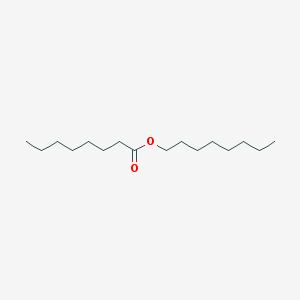
Octyl octanoate
| Molecular & Flavor Profile | |
|---|---|
| Common name: | Octyl octanoate |
| IUPAC name: | octyl octanoate |
| SMILES: | CCCCCCCCOC(=O)CCCCCCC |
| CAS: | 2306-88-9 |
| Flavor Profile: | oily, coconut, fruity |
| FEMA Flavor Profile: | Fruit |
| FEMA Number: | 2811 |
| Taste: | Not Available |
| Odor: | Not Available |
| Functional Groups: | carboxylic acid derivative, carboxylic acid ester |
Entities that contain Octyl octanoate
- Origin of this compound is unknown
Physicochemical Properties
- Molecular weight: 256.43 g/mol
- HBD count: 0
- HBA count: 2
- Number of rotatable bonds: 14
- Complexity: 178.0
- Topological Polor Surface Area: 26.3 A^2
- Monoisotopic Mass: 256.24 g/mol
- Exact Mass: 256.24 g/mol
- XlogP: 6.5
- Charge: 0 C(coulomb)
- Heavy Atom Count: 18
- Atom Stereocenter Count: 0
- Defined Atom Stereocenter Count: 0
- Undefined Atom Stereocenter Count: 0
- Bond Stereocenter Count: 0
- Defined Bond Stereocenter Count: 0
- Undefined Bond Stereocenter Count: 0
- Isotope Atom Count: 0
- Covalently Bonded Unit Count: 1
- InChI: InChI=1S/C16H32O2/c1-3-5-7-9-11-13-15-18-16(17)14-12-10-8-6-4-2/h3-15H2,1-2H3
- Volume 3D: 228.2
Nomenclature
- Common name: Octyl octanoate
- IUPAC name: octyl octanoate
- CAS numbers: 2306-88-9
- SMILES: CCCCCCCCOC(=O)CCCCCCC
- InChI: InChI=1S/C16H32O2/c1-3-5-7-9-11-13-15-18-16(17)14-12-10-8-6-4-2/h3-15H2,1-2H3
- FlavorDB/FEMA name: OCTYL OCTANOATE
- Synonyms: n-Octyl octoate; Octyl octylate; Octanoic acid, octyl ester; Octyl caprylate; n-Octyl caprylate; Octyl octanoate
- FL number: 9.114
- NAS number: 2811
- CoE number: 395
- EINECS number: 218-980-5
- JECFA number: 177
Description
- Flavor profile: oily, coconut, fruity
- FooDB flavor profile: oily, coconut, fruity
- FEMA flavor profile: Fruit
- Functional groups: carboxylic acid derivative, carboxylic acid ester
- Bitter compound: No
- Source description: Octyl octanate has a faint, fatty odor reminiscent of green tea and an oily, fruity, sweet, mildly green taste
Regulatory Status
- CoE status: 0.5 ppm
- FDA status: 21 CFR 172.515
- JECFA status: Acceptable. No safety concern at current levels of intake when used as a flavoring agent (1997)
Natural Occurence
- Occurrence summary: No curated occurrence record
- Source entity count: 0
- Documented natural occurrence: No data found
Composition
- Molecular formula: C16H32O2
- Molecular composition: C: 0.749, H: 0.126, O: 0.125
- Number of atoms: 18
ADMET Properties
- ADMET Solubility: -5.003
- ADMET Solubility Level: 2.0
- ADMET BBB: 1.3230000000000002
- ADMET BBB Level: 0.0
- ADMET EXT Hepatotoxic: -26.2325
- ADMET EXT Hepatotoxic prediction md: False
- ADMET EXT Hepatotoxic applicability: All properties and OPS components are within expected ranges.
- ADMET EXT Hepatotoxic applicability md: 7.12408
- ADMET EXT Hepatotoxic applicability mdpvalue: 0.9925729999999999
- ADMET Absorption Level: 1.0
- ADMET EXT PPB: -0.9453889999999999
- ADMET EXT PPB prediction: True
- ADMET EXT PPB applicability: All properties and OPS components are within expected ranges.
- ADMET EXT PPB applicability md: 9.60972
- ADMET EXT PPB applicability mdpvalue: 0.967887
- ADMET unknown AlogP98: 0.0
- ADMET AlogP98: 6.122000000000001
- ADMET PSA 2D: 26.23
2D/3D Properties
- Number of atoms: 18
- Molecular formula: C16H32O2
- Molecular composition: C: 0.749, H: 0.126, O: 0.125
- Molecular mass: 256.24 g/mol
- Energy: 3.83 Kcal/M
- AlogP: 6.122000000000001
- LogD: 6.122000000000001
- Molecular Solubilty: -5.994
- Number of aromatic bonds: 0
- Number of aromatic rings: 0
- Number of H acceptor: 2
- Number of H acceptor lipinski: 2
- Number of H donor: 0
- Number of H donor lipinski: 0
- Number of H bonds: 0
- Number of rings: 0
- Surface area(SA): 325.74 A^2
- Molecular SASA(Solvent accessible SA): 552.226 A^2
- Radius of gyration: 2.1625400000000004 A
- Molecular 3D SASA: 484.28 A^2
Consumption
- Consumption: <1.00 lb
- Individual intake: 0.00000001 mg/kg/day
- Trade association guidelines: 0.126 mg
- IOFI: Nature Identical
Specifications
- Specifications: (JECFA, 2000); Appearance; Colorless liquid; Refractive index; 1.4352–1.4925 (20°C); Assay (min); 98%; Solubility; Soluble in alcohol; insoluble in water; Boiling point; 306–307°C; Specific gravity; 0.8554 (25°C); Melting point; –18°C
Reported Uses
- Reported uses (ppm): (FEMA, 1994)
-
Food category usual/max:
Food category Usual (ppm) Max (ppm) Alcoholic beverages 0.10 1.00 Gelatins, puddings 0.42 1.02 Baked goods 0.50 1.16 Nonalcoholic beverages 0.33 1.00 Frozen dairy 0.33 1.00 Soft candy 0.54 1.20
Synthesis
- Synthesis: By esterification of octanoic acid with octyl alcohol in the presence of HCl catalyst; or by passing vapors of octanoic acid and hydrogen over a copper chromium oxide catalyst at high temperature (320°C)
Physical-Chemical Characteristics
- Empirical formula / MW: C16H32O2/256.43
Details of "Molecular & Flavor Profile" and physicochemical properties were obtained from PubChem Substance & Compound Databases, FooDB, Flavornet, SuperSweet, and BitterDB. 2D/3D and ADMET properties were obtained with Discovery Studio.