Beta-Pinene
| Molecular & Flavor Profile | |
|---|---|
| Common name: | Beta-Pinene |
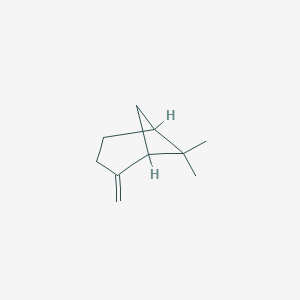
| IUPAC name: | 6,6-dimethyl-4-methylidenebicyclo[3.1.1]heptane |
| SMILES: | CC1(C2CCC(=C)C1C2)C |
| CAS: | 127-91-3, 25719-60-2, 127-91-3, 18172-67-3 |
| Flavor Profile: | resinous, resin, turpentine, green, hay, woody, pine, dry |
| FEMA Flavor Profile: | Pine , Polish , Wood |
| FEMA Number: | 2903 |
| Taste: | piney, turpentine-like taste |
| Odor: |
characteristic turpentine odor dry, woody or resinous aroma piney, turpentine-like odor terpene odor |
| Functional Groups: | alkene |
Entities that contain Beta-Pinene
- Gin
- Rum
- Bourbon Whisky
- Oats
- Rice
- Corn
- Cheddar Cheese
- Swiss Cheese
- Milk Fat
- Buchu
- Chamomile
- Citrus Peel Oil
- Eucalyptus
- Hops Oil
- Hyssop Oil
- Lovage
- Mastic Gum
- Clary Sage
- Spanish Sage
- Clam
- Crayfish
- Fatty Fish
- Apple
- Apricot
- Cherimoya
- Currant
- Black Currant
- Red Currant
- White Currant
- Fig
- Guava
- Kiwifruit
- Litchi
- Mango
- Orange
- Peach
- Plum
- Starfruit
- Tamarind
- Bilberry
- Blackberry
- Cranberry
- Gooseberry
- Lingonberry
- Raspberry
- Citrus Fruits
- Lemon
- Lime
- Mandarin Orange
- Vanilla
- Mushroom
- Angelica
- Artemisia
- Basil
- Buckwheat
- Calamus
- Coriander
- Cornmint
- Dill
- Fennel
- Mint
- Rosemary
- Sage
- Spearmint
- Tarragon
- Thyme
- Beef
- Chicken
- Soybean
- Filbert
- Pecans
- Laurel
- Myrtle
- Tea
- Anise
- Anise Hyssop
- Star Anise
- Caraway
- Cardamom
- Cassia
- Celery
- Cinnamon
- Clove
- Cumin
- Ginger
- Mace
- Marjoram
- Nutmeg
- Oregano
- Parsley
- Pepper
- Saffron
- Turmeric
- Peppermint
- Capsicum
- Tomato
- Carrot
- Parsnip
- Potato
- Allspice
- Asafoetida
- Bittergourd
- Canola Oil
- Carom Seed
- Nigella Seed
- Pomegranate
- Ricotta Cheese
- Pummelo
- Sunflower
- Summer savory
- Winter savory
Physicochemical Properties
- Molecular weight: 136.238 g/mol
- HBD count: 0
- HBA count: 0
- Number of rotatable bonds: 0
- Complexity: 177.0
- Topological Polor Surface Area: 0.0 A^2
- Monoisotopic Mass: 136.125 g/mol
- Exact Mass: 136.125 g/mol
- XlogP: 3.1
- Charge: 0 C(coulomb)
- Heavy Atom Count: 10
- Atom Stereocenter Count: 2
- Defined Atom Stereocenter Count: 0
- Undefined Atom Stereocenter Count: 2
- Bond Stereocenter Count: 0
- Defined Bond Stereocenter Count: 0
- Undefined Bond Stereocenter Count: 0
- Isotope Atom Count: 0
- Covalently Bonded Unit Count: 1
- InChI: InChI=1S/C10H16/c1-7-4-5-8-6-9(7)10(8,2)3/h8-9H,1,4-6H2,2-3H3
- Volume 3D: 119.6
Nomenclature
- Common name: Beta-Pinene
- IUPAC name: 6,6-dimethyl-4-methylidenebicyclo[3.1.1]heptane
- CAS numbers: 127-91-3, 25719-60-2, 127-91-3, 18172-67-3
- SMILES: CC1(C2CCC(=C)C1C2)C
- InChI: InChI=1S/C10H16/c1-7-4-5-8-6-9(7)10(8,2)3/h8-9H,1,4-6H2,2-3H3
- FlavorDB/FEMA name: β-PINENE
- Synonyms: 6,6-Dimethyl-2-methylene. norpinane; Nopinene; Bicyclo(3 1 1)heptane, 6,6-dimethyl-2-methylene-; 6,6-Dimethyl-2-methylenebicyclo(3 1 1)heptane; 6,6-Dimethyl-2-methylene-bicyclo(3 1 1)heptane; Pinene; Pinene,. beta; Pin-2(10)-ene; beta-Pinene; 2(10)-Pinene; Pseudopinen; Pseudopinene; Terbenthene; 2,2,6-Trimethylbicyclo(3 1 1)hept-2-ene
- FL number: 1.003
- NAS number: 2903
- CoE number: 2114
- EINECS number: 204-872-5
- JECFA number: 1330
Description
- Flavor profile: resinous, resin, turpentine, green, hay, woody, pine, dry
- FooDB flavor profile: resinous, resin, turpentine, green, hay, woody, pine, dry
- FEMA flavor profile: Pine, Polish, Wood
-
Odor:
characteristic turpentine odor
dry, woody or resinous aroma
piney, turpentine-like odor
terpene odor - Taste: piney, turpentine-like taste
- Functional groups: alkene
- Bitter compound: No
- Source description: β-Pinene has a characteristic turpentine odor with a dry, woody or resinous aroma
Regulatory Status
- CoE status: 600 ppm
- FDA status: 21 CFR 172.515, 172.615
- JECFA status: Acceptable. No safety concern at current levels of intake when used as a flavoring agent (2004)
Aroma/Taste Threshold Values
- Aroma threshold values: 140 ppb. Aroma characteristics at 10%; cooling, woody, piney and turpentine-like with a fresh minty, eucalyptus and camphoraceous note with a spicy peppery and nutmeg nuance
- Taste threshold values: Taste characteristics at 15 to 100 ppm; fresh, piney and woody, terpy and resinous with a slight minty, spicy and camphoraceous nuance
Natural Occurence
- Occurrence summary: Naturally occurring; Reported in 111 FlavorDB source entities
- Source entity count: 111
- Representative sources: Gin, Rum, Bourbon Whisky, Oats, Rice, Corn, Cheddar Cheese, Swiss Cheese, Milk Fat, Buchu
- Documented natural occurrence: Usually occurring together with α-pinene but in smaller amounts; the d- and l-forms are reported found in the essential oils of various Artemisae and several Cupressaceae, in coriander and cumin; the l-form is a constituent of several citrus oils. β-Pinene is reported found in over 190 natural products including apple, apricot, many citrus juices and peel oils, bilberry, cran-berry, lingonberry, blackberry, currants, guava, raspberry, strawberry, basil, carrot, celery, cooked potato, bell pepper, tomato, anise seed oil, cinnamon, cassia leaf, clove, cumin, ginger, Mentha oils, nutmeg, mace, pepper, parsley, thyme, Swiss and cheddar cheese, cream, fatty fish, fried chicken, beef fat, hop oil, rum, bourbon whiskey, tea, roasted filberts, pecans, oats, soybean, plum, mushroom, sweet and wild marjoram, starfruit, mango, tamarind, cardamom, coriander, gin, rice, litchi, calamus, dill, lovage, caraway seed, buckwheat, laurel, fennel, kiwifruit, myrtle leaf and berry, rosemary, buchu oil, Bourbon vanilla, Spanish and clary sage, nectarine, crayfish, clam, cape gooseberry, anise hyssop, angelica root oil, Roman and German chamomile oil, eucalyptus oil, bullock’s heart and mastic gum leaf and fruit oil
Composition
- Molecular formula: C10H16
- Molecular composition: C: 0.882, H: 0.118
- Number of atoms: 10
ADMET Properties
- ADMET Solubility: -3.715
- ADMET Solubility Level: 3.0
- ADMET BBB: 0.75
- ADMET BBB Level: 0.0
- ADMET EXT Hepatotoxic: -5.87681
- ADMET EXT Hepatotoxic prediction md: False
- ADMET EXT Hepatotoxic applicability: All properties and OPS components are within expected ranges.
- ADMET EXT Hepatotoxic applicability md: 8.67858
- ADMET EXT Hepatotoxic applicability mdpvalue: 0.619838
- ADMET Absorption Level: 0.0
- ADMET EXT PPB: -1.6105399999999999
- ADMET EXT PPB prediction: True
- ADMET EXT PPB applicability: All properties and OPS components are within expected ranges.
- ADMET EXT PPB applicability md: 8.38808
- ADMET EXT PPB applicability mdpvalue: 0.9998549999999999
- ADMET unknown AlogP98: 0.0
- ADMET AlogP98: 2.926
- ADMET PSA 2D: 0.0
2D/3D Properties
- Number of atoms: 10
- Molecular formula: C10H16
- Molecular composition: C: 0.882, H: 0.118
- Molecular mass: 136.125 g/mol
- Energy: 36.46 Kcal/M
- AlogP: 2.926
- LogD: 2.926
- Molecular Solubilty: -2.414
- Number of aromatic bonds: 0
- Number of aromatic rings: 0
- Number of H acceptor: 0
- Number of H acceptor lipinski: 0
- Number of H donor: 0
- Number of H donor lipinski: 0
- Number of H bonds: 0
- Number of rings: 3
- Surface area(SA): 163.42 A^2
- Molecular SASA(Solvent accessible SA): 302.068 A^2
- Radius of gyration: 1.1965 A
- Molecular 3D SASA: 295.628 A^2
Consumption
- Consumption: 7833.33 lb
- Individual intake: 0.006638 mg/kg/day
- Trade association guidelines: 6.777 mg
- IOFI: Nature Identical
Specifications
- Specifications: (JECFA, 2008); Acid value (max); <1.0; Refractive index; 1.476–1.482 (20°C); Appearance; Colorless mobile liquid; Solubility; Soluble in oils; insoluble in water ans ; ethanol; Assay (min); 97% C10H16; Specific gravity; 0.867–0.871 (25°C); Boiling point; 163–166°C
Reported Uses
- Reported uses (ppm): (FEMA, 1994)
-
Food category usual/max:
Food category Usual (ppm) Max (ppm) Alcoholic beverages 9.64 15.52 Gelatins, puddings 9.77 14.88 Baked goods 26.12 98.16 Hard candy 14.90 76.54 Chewing gum 17.24 23.31 Meat products 8.81 17.63 Condiments, relishes 20.00 40.00 Nonalcoholic beverages 11.24 21.21 Frozen dairy 20.12 49.73 Soft candy 20.34 74.43
Synthesis
- Synthesis: Isolated from American turpentine; also by conversion from α-pinene; as an intermediate extremely important for the manufacture of citral, citronellol, hydroxycitronellal, geraniol, citronellal, linalool, ionones, methylionones and menthol
Physical-Chemical Characteristics
- Empirical formula / MW: C10H16/136.24
Details of "Molecular & Flavor Profile" and physicochemical properties were obtained from PubChem Substance & Compound Databases, FooDB, Flavornet, SuperSweet, and BitterDB. 2D/3D and ADMET properties were obtained with Discovery Studio.