D-Limonene
| Molecular & Flavor Profile | |
|---|---|
| Common name: | D-Limonene |
| IUPAC name: | (4R)-1-methyl-4-prop-1-en-2-ylcyclohexene |
| SMILES: | CC1=CCC(CC1)C(=C)C |
| CAS: | 5989-27-5, 68606-81-5, 5989-27-5, 65996-98-7 |
| Flavor Profile: | mint, lemon, citrus, orange, fresh, sweet |
| FEMA Flavor Profile: | Citrus , Mint |
| FEMA Number: | 2633 |
| Taste: | fresh, citrus taste |
| Odor: | citrus odor |
| Functional Groups: | alkene |
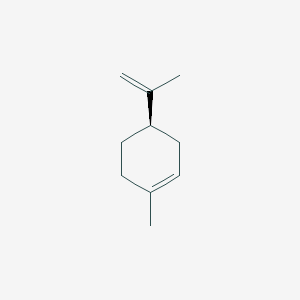
Physicochemical Properties
- Molecular weight: 136.238 g/mol
- HBD count: 0
- HBA count: 0
- Number of rotatable bonds: 1
- Complexity: 163.0
- Topological Polor Surface Area: 0.0 A^2
- Monoisotopic Mass: 136.125 g/mol
- Exact Mass: 136.125 g/mol
- XlogP: 3.4
- Charge: 0 C(coulomb)
- Heavy Atom Count: 10
- Atom Stereocenter Count: 1
- Defined Atom Stereocenter Count: 1
- Undefined Atom Stereocenter Count: 0
- Bond Stereocenter Count: 0
- Defined Bond Stereocenter Count: 0
- Undefined Bond Stereocenter Count: 0
- Isotope Atom Count: 0
- Covalently Bonded Unit Count: 1
- InChI: InChI=1S/C10H16/c1-8(2)10-6-4-9(3)5-7-10/h4,10H,1,5-7H2,2-3H3/t10-/m0/s1
- Volume 3D: 123.2
Nomenclature
- Common name: D-Limonene
- IUPAC name: (4R)-1-methyl-4-prop-1-en-2-ylcyclohexene
- CAS numbers: 5989-27-5, 68606-81-5, 5989-27-5, 65996-98-7
- SMILES: CC1=CCC(CC1)C(=C)C
- InChI: InChI=1S/C10H16/c1-8(2)10-6-4-9(3)5-7-10/h4,10H,1,5-7H2,2-3H3/t10-/m0/s1
- FlavorDB/FEMA name: LIMONENE (d-, l-, and dl-)
- Synonyms: Cajeputene; Carvene; Dipentene; Kautschin; 1,8(9)-p-Menthadiene; p-Mentha-1,8-diene; 1-Methyl-4-isopropenyl-1-cyclohexene; Cyclohexene, 1-methyl-4-(1-methyl ethenyl)-, (+/–)-; (+/–)-Dipentene; DL-4-Isopropenyl-1-methylcyclohexene; Limonene; DL-Limonene; (+/–)-Limonene; p-Mentha-1,8-diene, (+/–)-; Mentha-1,8-diene (DL); (+/–)-1-Methyl-4-(1-methylethenyl)cyclohexene; (1)-1-Methyl-4-(1-methylvinyl)-cyclohexene
- FL number: 1.001
- NAS number: 2633
- CoE number: 491
- EINECS number: 227-813-5 (d)277-815-6 (l)205-341-0 (dl)
- JECFA number: 1326
Description
- Flavor profile: mint, lemon, citrus, orange, fresh, sweet
- FooDB flavor profile: mint, lemon, citrus, orange, fresh, sweet
- FEMA flavor profile: Citrus, Mint
- Odor: citrus odor
- Taste: fresh, citrus taste
- Functional groups: alkene
- Bitter compound: No
- Source description: d-, l- or dl-Limonene has a pleasant, lemon-like odor free from camphoraceous and turpentine-like notes. Limonene is the most important and widespread terpene; it is known in the d- and l- optically active forms and in the optically inactive dl-form (known as dipentene)
Regulatory Status
- CoE status: 400 ppm
- FDA status: 21 CFR 182.60, 582.60 (d-, dl-, and l-forms)
- JECFA status: Not specified (1993)
Aroma/Taste Threshold Values
- Aroma threshold values: 4 to 229 ppb
- Taste threshold values: Taste characteristics at 30 ppm; sweet, orange, citrus and terpy
Natural Occurence
- Occurrence summary: Naturally occurring; Reported in 32 FlavorDB source entities
- Source entity count: 32
- Representative sources: Hops Oil, Hyssop Oil, Guava, Orange, Lemon, Calamus, Coriander, Dill, Fennel, Rosemary
- Documented natural occurrence: It has been reported found in more than 300 essential oils in amounts ranging from 90 to 95% (lemon, orange, mandarin) to as low as 1% (palmarosa); the most widespread form is the d-limonene, followed by the racemic form and then l-limo-nene. Also reported found in ginger, nutmeg, pepper, mace, hop oil, coriander seed, calamus, dill herb, caraway seed and rosemary
Composition
- Molecular formula: C10H16
- Molecular composition: C: 0.882, H: 0.118
- Number of atoms: 10
ADMET Properties
- ADMET Solubility: -3.844
- ADMET Solubility Level: 3.0
- ADMET BBB: 0.9279999999999999
- ADMET BBB Level: 0.0
- ADMET EXT Hepatotoxic: -9.94406
- ADMET EXT Hepatotoxic prediction md: False
- ADMET EXT Hepatotoxic applicability: All properties and OPS components are within expected ranges.
- ADMET EXT Hepatotoxic applicability md: 9.25896
- ADMET EXT Hepatotoxic applicability mdpvalue: 0.331919
- ADMET Absorption Level: 0.0
- ADMET EXT PPB: 0.594508
- ADMET EXT PPB prediction: True
- ADMET EXT PPB applicability: All properties and OPS components are within expected ranges.
- ADMET EXT PPB applicability md: 9.26091
- ADMET EXT PPB applicability mdpvalue: 0.990481
- ADMET unknown AlogP98: 0.0
- ADMET AlogP98: 3.502
- ADMET PSA 2D: 0.0
2D/3D Properties
- Number of atoms: 10
- Molecular formula: C10H16
- Molecular composition: C: 0.882, H: 0.118
- Molecular mass: 136.125 g/mol
- Energy: 2.38 Kcal/M
- AlogP: 3.502
- LogD: 3.502
- Molecular Solubilty: -2.499
- Number of aromatic bonds: 0
- Number of aromatic rings: 0
- Number of H acceptor: 0
- Number of H acceptor lipinski: 0
- Number of H donor: 0
- Number of H donor lipinski: 0
- Number of H bonds: 0
- Number of rings: 1
- Surface area(SA): 174.06 A^2
- Molecular SASA(Solvent accessible SA): 333.50199999999995 A^2
- Radius of gyration: 1.60178 A
- Molecular 3D SASA: 309.153 A^2
Consumption
- Consumption: 133,666.67 lb
- Individual intake: 0.1132 mg/kg/day
- Trade association guidelines: 115.657 mg
- IOFI: Natural
Specifications
- Specifications: (JECFA, 2008); Acid value (max); <1.0; Refractive index; 1.471–1.477 (20°C); Appearance; Colorless mobile liquid; Solubility; Insoluble in water, propylene glycol; ; slightly soluble in glycerol; soluble in ; oils and ethanol; Assay (min); 96% (sum of isomers); Specific gravity; 0.838–0.843 (25°C); Boiling point; 175–177°C; Specific rotation; +96 to +104° (25°C); compounds ; present above 0.5%:; linalool, ; myrcene
Reported Uses
- Reported uses (ppm): (FEMA, 1994)
-
Food category usual/max:
Food category Usual (ppm) Max (ppm) Alcoholic beverages 792.70 812.30 Gravies 1.50 3.00 Baked goods 342.40 500.50 Hard candy 1043.00 1390.00 Chewing gum 343.00 3024.00 Meat products 70.63 79.74 Condiments, relishes 10.00 20.00 Nonalcoholic beverages 178.60 198.80 Frozen dairy 339.20 436.80 Soft candy 388.70 511.80 Gelatins, puddings 346.70 451.80
Synthesis
- Synthesis: d-Limonene may be obtained by steam distillation of citrus peels and pulp resulting from the production of juice and cold-pressed oils, or from deterpenation of citrus oils; it is sometimes redistilled
Physical-Chemical Characteristics
- Empirical formula / MW: C10H16O/136.24
Details of "Molecular & Flavor Profile" and physicochemical properties were obtained from PubChem Substance & Compound Databases, FooDB, Flavornet, SuperSweet, and BitterDB. 2D/3D and ADMET properties were obtained with Discovery Studio.